| |
| |
|
|
 |
|
|
|
|
 |
 |
| |
|
 Prime Minister and Ban Ki-Moon Hold Joint Press Conference Prime Minister and Ban Ki-Moon Hold Joint Press Conference
|
| 13/04/2015 |
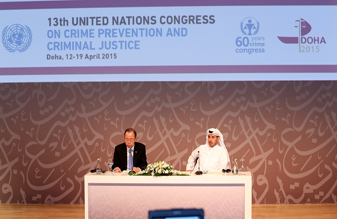
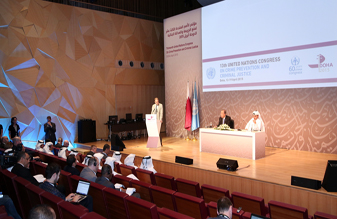
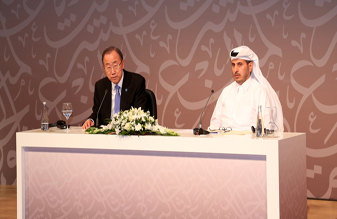
H.E the Prime Minister and Minister of Interior and president of the 13th UN Congress and the Secretary General of the UN H.E Ban Ki-moon held a joint press conference on Sunday, 12/4/2015 evening at Qatar National Convention Centre in Doha.
Addressing the media, H.E the Prime Minister said “I am pleased to express my deep satisfaction on the consultations witnessed by the Congress and the recommendations contained in the Doha Declaration, which sought to live up the size of the challenges and risks to all peoples of the world due to the growing phenomenon of crime and its effects and severe risk to the security and stability. No doubt that the importance of holding this conference lies in the change occurred in the international community over the past decade and which witnessed a change in the types and forms of crime that threatens the stability and security of societies, particularly corruption, terrorism and organized crime, whether national or transnational levels”.
H.E the Prime Minister added that this conference has witnessed the full compatibility between states and international organizations, civil society and other participants on the importance of achieving the goals of the conference, which confirms that everyone's commitment to the spirit of shared responsibility to prevent all forms of crimes and following the criminals and achieving criminal justice at all national and international levels.
The effective measures and means for crime prevention and criminal justice have utmost importance in the conference discussions, particularly, the development and strengthening of the fair and creative criminal justice system, for both the justice and police agencies and at the legislation or institutional levels, or other means, including the role of penal institutions, H.E the Prime Minister stated.
While speaking in the press conference, H.E Ban Ki – moon said that, I just had a productive meeting with the Prime Minister of Qatar, His Excellency Sheikh Abdullah bin Nasser bin Khalifa Al-Thani. I thanked the President of the Congress and Prime Minister for hosting the thirteenth United Nations Congress on Crime Prevention and Criminal Justice and I congratulated him on the successful adoption by consensus of the Doha Declaration. I believe the Declaration to be implementable, concise and achievable. I expect this conference to be action-driven. It should provide a platform to increase the cooperation between Governments, intergovernmental organizations and civil society from the full spectrum on crime prevention and criminal justice issues. I really appreciate and highly commend the leadership of the President of the Congress and Prime Minister.
The Prime Minister and I discussed a range of subjects of mutual concern, including transnational crime and terrorism. One of the biggest security threats, challenges we face is the rise of Da’esh or ISIL. The international community has to address the conditions that allow groups like Da’esh or ISIL to emerge and grow. On April 21 and 22, there will be a high-level UN General Assembly thematic debate on tolerance and reconciliation organized in close cooperation with the Alliance of Civilizations Initiative. Later in the year, I also plan to present a comprehensive UN Plan of Action on preventing violent extremism, including through good governance, the rule of law, engaging women and youth and all those alienated from our societies, he added.
Speaking about the situation, the UN Secretary General said, In Iraq, I welcome the recent liberation of Tikrit. But I am alarmed by allegations of serious human rights violations and destruction of property perpetrated by forces and militias fighting alongside the Iraqi forces. I am pleased that the Government of Iraq is taking these reports seriously and has urged the protection of civilians and their property. I encourage the Government of Iraq to restore the rule of law in areas liberated from Da’esh or ISIL. Alleged violations or abuses of human rights must be investigated and perpetrators held to account. Over 2.5 million people have now been displaced in Iraq. Minority communities, women and children remain particularly affected. The Government of Iraq and the Kurdistan Regional Government, with the support of the international community, have been working to scale up their emergency relief efforts. However, vast challenges remain and additional resources are urgently needed.
In Yemen, I have strongly objected to the Houthis attempting to control the country by force. This is unacceptable. But I am also deeply concerned about the military escalation. Civilian casualties are mounting and vital public infrastructure is being destroyed. The internal crisis in Yemen should not be allowed to grow into a protracted regional conflict. We urgently need a de-escalation and a return to peaceful negotiations, said Ban Ki-moon talking about Yemen.
I firmly believe that the UN-brokered negotiations remain the best chance to prevent a long drawn out conflict, and I strongly support the efforts of my Special Envoy Jamal Benomar. Life-saving humanitarian assistance in Yemen is continuing to the extent possible through national staff and a network of local partners.
In Gaza, I remain deeply concerned by continuing tensions. I thank Qatar for its generous support towards rebuilding Gaza, and I urge all donors to fully meet the commitments they made in Cairo last October. I also urge the Palestinians to overcome their divisions. The blockade must be lifted with due consideration for Israel's legitimate security concerns.I am also deeply worried by the lack of a political horizon, which, combined with the situation on the ground, calls into question the prospects for resumed negotiations. There is no other solution to the Israeli-Arab conflict than the establishment of a viable, contiguous and democratic Palestinian State living side-by-side in peace and security with Israel, he added.
Talking about Iran, he said, on Iran, the recent political framework achieved by the P5+1 and Iran is a significant development. It paves the way for a comprehensive joint plan of action by 30 June as agreed by the negotiating parties. The agreement will be of historical international value, providing for substantial limits on Iran’s nuclear programme and, at the same time, for the removal of sanctions. It will respect Iran’s needs and rights while providing assurances to the international community that Iran’s nuclear activities will remain exclusively peaceful. I strongly believe that a comprehensive, negotiated solution to the Iranian nuclear issue will contribute to peace and stability in the region.
|
|
|
|
|
|
|
|
|
|